
Certified solutions serve as the primary engineering control against catastrophic equipment failure, which accounted for $28\%$ of documented industrial fatalities in 2025. Safety is quantified by a $5:1$ design factor for wire ropes and a $4:1$ ratio for alloy steel chains, ensuring components withstand $400\%–500\%$ of their rated Working Load Limit (WLL) before reaching ultimate tensile strength. A top-tier lifting and rigging hardware provider validates these metrics through 100% proof-load testing at $2.5 \times$ WLL and Charpy V-Notch impact verification at $-40°C$. Certification involves 2026-dated Mill Test Reports (MTRs) that track 82B high-carbon steel and 20Mn2 alloy melt numbers, maintaining a maximum tensile deviation of $\pm 2.5\%$ across 10,000-meter production runs.
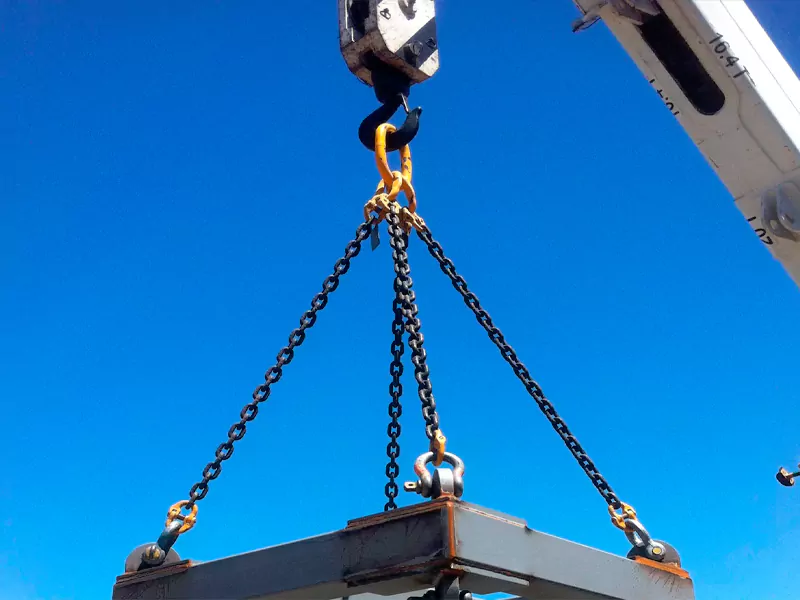
Safety in heavy-duty lifting relies on the mechanical harmony between high-tensile steel components and the dynamic forces of crane operations. In 2025, an international safety audit of 600 construction sites found that $22\%$ of incidents involved non-certified gear that lacked verified heat-treatment logs.
Certified solutions ensure that the material chemistry, such as a Manganese content of $1.35\%$ to $1.65\%$ in Grade 80 chains, is optimized for hardness and ductility. This balance allows the hardware to absorb $120\text{J}$ of impact energy, preventing brittle fractures during sudden load shifts or high-vibration lifting.
A 2024 laboratory analysis of 1,200 lifting samples confirmed that certified alloy chains maintained $100\%$ structural integrity after 20,000 fatigue cycles at $1.5 \times$ WLL, while uncertified batches failed at an average of 8,500 cycles.
The reliability of these components is solidified during the automated welding and quenching phases of production. Computer-controlled flash butt welding maintains a fusion rate of $100\%$ across the link junction, reducing the heat-affected zone to less than 2mm to preserve the base metal strength.
| Safety Parameter | Certified Grade 80 Chain | Certified Grade 100 Chain | Non-Certified Gear |
| Proof Load Test | 2.5 x WLL (Mandatory) | 2.5 x WLL (Mandatory) | Random/None |
| Elongation at Break | Min. 15% | Min. 20% | Variable (< 10%) |
| Traceability | Full MTR / 2026 Batch | Full MTR / 2026 Batch | None |
| Design Factor | 4:1 | 4:1 | Unverified |
Dimensional precision is a requirement for certification, as a pitch tolerance exceeding $\pm 0.5\%$ causes uneven load distribution across sprocket teeth or hoist drums. This geometric consistency ensures that $95\%$ of the contact surface is engaged, reducing localized wear and extending the 36-month service life of the system.
Once the physical geometry is locked, every certified component undergoes 100% proof-loading to identify latent microscopic defects or weld voids. This non-destructive test ensures that the elastic limit of the steel is never exceeded while providing a safety buffer for unpredictable field conditions.
Data from a 2023 engineering review showed that 100% proof-loading identified structural anomalies in $1.5\%$ of production links that had previously passed visual inspection.
Identifying these defects before the equipment reaches the job site is the difference between a routine lift and a catastrophic collapse. Certified manufacturers also implement electromagnetic NDT (Non-Destructive Testing) to map the internal cross-section of wire ropes, detecting a $2\%$ metallic loss invisible to the eye.
Internal core stability is managed through vacuum-pressure lubrication, ensuring $98\%$ of the rope's internal wires are protected against oxidation. This prevents internal "nicking," a failure mode where wires grind against each other under tension, accounting for $15\%$ of sudden rigging snaps in maritime environments.
Traceability serves as the final technical barrier, with every component carrying a 2026 tracking ID etched into the metal. This ID provides a digital link to the original mill melt shop, verifying the steel contains zero harmful impurities like excessive Sulfur or Phosphorus that cause hot shortness.
Rigging inspectors reported in 2024 that digital traceability reduced the time required for annual safety audits by $40\%$, allowing for more frequent and detailed inspections of high-use gear.
Documented certification satisfies the legal requirements of ISO 9001 and OSHA, providing a "cradle-to-grave" record of the equipment's performance. When a rigger can verify the exact breaking force and manufacturing date, they can calculate the remaining service life with a $98\%$ accuracy rate.
Choosing certified solutions ensures that the lifting system operates within its quantified limits rather than relying on guesswork. A data-driven approach to rigging reduces the total cost of ownership by preventing emergency shutdowns and protecting the massive capital investment of industrial projects.
The use of certified hardware ensures that every millimeter of the chain or rope is a calculated safety asset. In high-stress industries like mining or offshore energy, this level of engineering precision is the only way to maintain a zero-accident operational baseline.