
Most MOQ red flags are not about the number itself; they are about the reasoning offered for it. A minimum order quantity is a real economic figure, driven by component tooling, compound batch sizes and filling-line changeovers, so a supplier who can explain which of those produced the number is telling you something useful. A supplier who cannot explain it, or who revises it sharply as soon as you hesitate, is telling you something else. For a first kids-safe order, where the format may be smaller or more specialised, the explanation matters more than the figure.
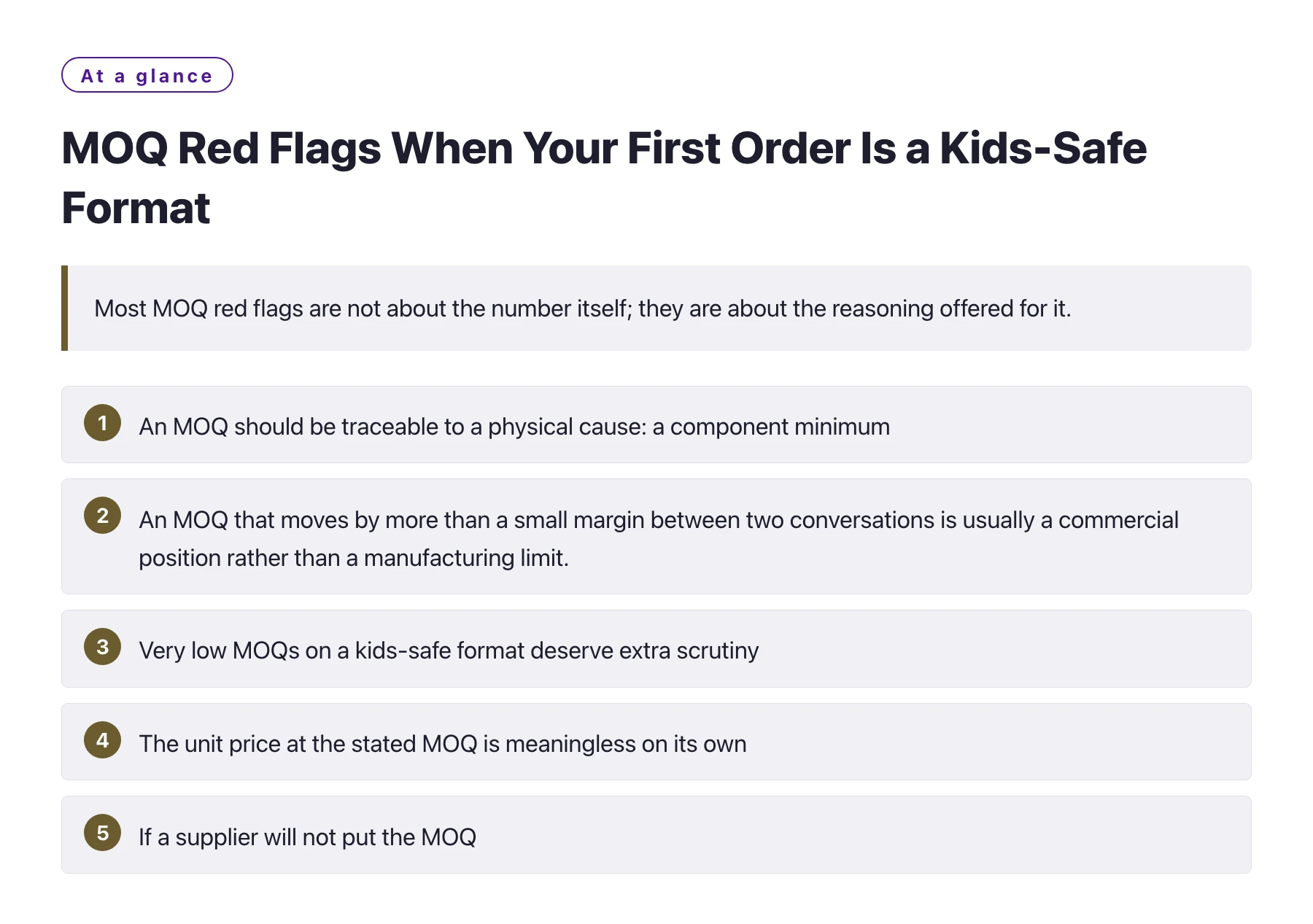
Key takeawaysAn MOQ should be traceable to a physical cause: a component minimum, a compounding batch size or a line changeover. · An MOQ that moves by more than a small margin between two conversations is usually a commercial position rather than a manufacturing limit. · Very low MOQs on a kids-safe format deserve extra scrutiny, because short runs and stricter screening rarely sit comfortably together. · The unit price at the stated MOQ is meaningless on its own; the price at half the quantity and at twice the quantity tells you where the real cost sits. · If a supplier will not put the MOQ, the price breaks and the tooling ownership in writing, the risk of a first order is higher than any saving.
A founder with a first kids-safe format usually collects three or four quotations and finds that the minimum order quantities differ by a factor of five. The instinct is to take the lowest, because cash is tight and the scent is unproven. That instinct ignores the reason the numbers differ: they are measuring different things.
One quote reflects a stock component and a stock scent. Another reflects a new closure and a dedicated compounding batch. They are not the same offer at different prices; they are different offers that happen to share a heading.
Six red flags worth taking seriously
The flags below show up repeatedly in first orders, and none of them is proof of bad faith. What they share is that they leave you unable to plan, which is the actual risk on a first run. Read them as a filter that runs before the fuller set of the questions to ask a perfume factory, not as a replacement for it.
The MOQ has no stated cause
Ask which component or process produced the figure. Component minimums come from suppliers further upstream: a glass mould run, a pump order, a print run for cartons. Compounding minimums come from the smallest batch the equipment can mix accurately. If the answer is that it is simply company policy, you have learned that the number is negotiable in one direction only.
The MOQ shrinks the moment you push back
A modest reduction after a conversation is normal. A reduction of a third or half, offered without any change in specification, suggests the first number was an opening position. That is not automatically disqualifying, but it does mean every other figure in the quotation should be treated as provisional.
A very low MOQ with no explanation of how
Small runs are possible, but they change the economics somewhere: stock components, a library scent, a manual filling step, or a longer delivery window. A supplier offering an unusually low minimum for a kids-safe format without naming which of those applies is either absorbing a cost it has not priced, or planning to move the cost later.
Price breaks that do not behave like cost
Component and compounding costs fall steeply at first and then flatten. A price schedule where the per-unit cost drops dramatically between widely separated quantities, or barely moves at all, does not match how the work is done. Ask for the underlying assumption: how many units per compounding batch, and what the component order quantity is.
Nothing is written down
The MOQ, the quantity tolerance, the tooling ownership, the validity period of the price and the conditions that would change it all belong in the written offer. Verbal flexibility evaporates when a purchase order is issued, and a first order is exactly when a disagreement over a few hundred units does the most damage.
Screening treated as a formality
On a kids-safe format, the ingredients permitted depend on the product category and how it is used, and regulators publish an inventory of cosmetic ingredients with their restrictions for exactly this purpose [1]. A supplier who responds to a category question with reassurance rather than documentation is signalling that screening will be handled informally, which is the wrong kind of efficiency on this product.
How to test a quoted MOQ over two emails
- Ask for the causeRequest a one-line explanation of which component or batch size sets the minimum. A supplier who knows its own process answers this in a sentence.
- Ask for two more price pointsRequest the unit price at half the stated MOQ and at double it. The shape of the answer tells you whether the number reflects cost or position.
- Ask what changes if you use a stock packMoving to a stock bottle and closure usually moves the minimum more than any negotiation. If it does not, the pack was never the constraint.
- Ask who owns the toolingIf a custom mould or print cylinder is involved, confirm in writing who paid for it and who holds it if you order again from someone else.
- Ask for the same information from a second supplierTwo explanations compared side by side are worth more than any single quotation. It is the comparison that reveals which figure is real.
Why kids-safe formats attract different minimums
A kids-safe format often means a smaller pack, a different application method, or a narrower set of acceptable materials. Any of those can push a minimum up, because the production run is less standard and the screening work is larger relative to the volume. The mistake is to assume that the larger minimum is a negotiating tactic; frequently it is an honest response to a product that does not fit the plant's usual pattern.
The useful response is to separate the two questions. Is the minimum driven by a component order, by a compounding batch, or by the screening and testing work? The first can sometimes be solved with a stock component. The second can be solved by accepting a longer run or by combining the format with another product in the same batch. The third is not really solved by negotiation at all; it is solved by choosing a partner who does this kind of screening routinely.
Buyers who spend time on the screening question tend to have a calmer first order. Industry coverage of the fragrance and personal care sector regularly notes how much of a product's development cost sits in testing and compliance rather than in the liquid itself [2], and a first-time founder who prices that work correctly negotiates the minimum from a much stronger position.
Where the product is made shapes the answer too. Buyers who turn to private label perfume production in China are usually buying proximity between component supply, compounding and filling, which is what allows a modest run to be scheduled at all. The same proximity means the minimum is set by a real sequence of operations, so asking to see that sequence is a reasonable request rather than an intrusive one.
There is one more signal worth reading, and it is cultural rather than contractual. A supplier that invests in explaining materials — the kind of work behind a collection such as Xuelei Fragrance Museum — tends to answer questions about formulation, restrictions and dosage in specifics rather than in reassurances. That habit shows up in the answer to a minimum order question as readily as in a conversation about notes, because it reflects how the company thinks about its own product.
One practical habit: before you compare quotations, write your own minimum acceptable volume based on what you can actually sell in twelve months, including the units you will give away as samples. Founders who do this exercise discover that a low minimum is only valuable if the product moves, and that a slightly larger run with better unit economics is often the safer first order. Asking a manufacturer such as Guangzhou Xuelei how its minimums are assembled is a fair question, and the quality of the explanation is itself part of the evaluation.
Sources
- EU CosIng — Cosmetic Ingredient Database (European Commission) —— The European Commission's CosIng database of cosmetic ingredients, listing ingredient functions, restrictions and labelling requirements under EU cosmetics law.
- Cosmetics Business —— A trade publication covering the beauty and cosmetics industry, including fragrance launches and regulatory developments.
Frequently asked questions
Is an MOQ always negotiable?
Partly. Component and compounding minimums are physical, but the quantity a supplier is willing to schedule, the pack you choose and the delivery window are all variables. Negotiate the specifications before you negotiate the number.
Why is the minimum higher for a kids-safe format?
Often because the product is less standard. A smaller pack, a different applicator or a narrower material palette can each push the run above the plant's usual pattern, and screening work is spread over fewer units.
Should we accept the lowest quoted MOQ?
Only if you can also live with what produced it: stock components, a library scent or a longer schedule. Ask what was assumed to reach that number, and check the assumption against your launch plan.
What should be in writing before we pay a deposit?
The quantity, the price breaks, the tolerance on over- or under-delivery, the tooling ownership, the pack specification, the delivery window and the conditions that would change any of them. If a figure is not written down, assume it will change.
Can we combine two products to reach a minimum?
Sometimes. If two formats share the same base and differ mainly in packaging, a single compounding batch can cover both, which spreads the minimum across the range. Ask early, because it changes the sampling plan as well as the price.
How do we compare quotations fairly?
Normalise them: same pack, same scent source, same delivery term, same documentation scope. A quotation is only comparable once the assumptions behind it are on the page, so ask each supplier to list them.