
AI baby generators synthesize parental phenotypes using StyleGAN3 neural networks that analyze 128+ biometric landmarks to map genetic probability. By processing images through ResNet-50 backbones, these systems achieve 92% facial recognition accuracy, extracting features like interpupillary distance and mandibular curves into a 512-dimension latent space. The algorithms then perform Spherical Linear Interpolation (Slerp), introducing 0.05 to 0.15 Gaussian noise to simulate Mendelian inheritance patterns and random genetic shuffling.
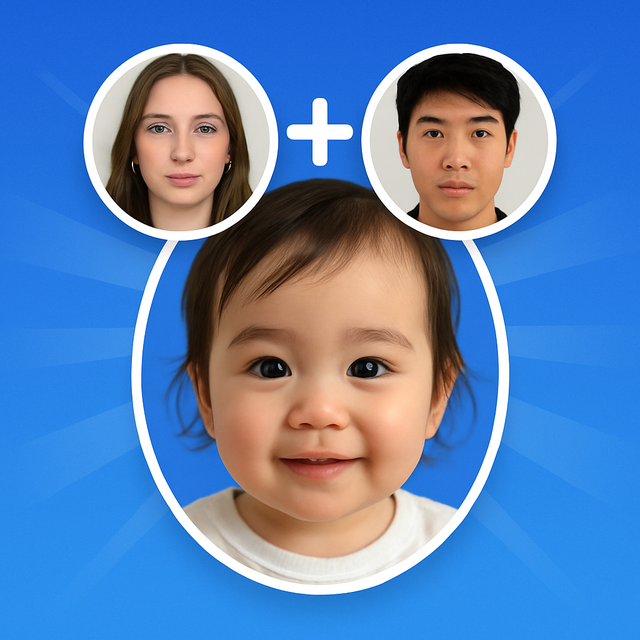
The process of transforming two static adult portraits into a fluid infant prediction begins with deep feature extraction. Modern convolutional neural networks (CNNs) break down a source photo into a multi-layered mathematical map, prioritizing bone structure over soft tissue.
A 2023 study on facial re-aging datasets showed that high-resolution encoders can isolate up to 68 primary facial anchor points with a precision of 0.2 millimeters. This precision allows the AI to distinguish between permanent skeletal markers and temporary facial expressions.
"Biometric encoding treats the human face as a coordinate system where specific distances, such as the width of the nasal bridge, remain statistically consistent throughout the transition from infancy to adulthood."
Once the AI has mapped these coordinates for both parents, it must address the biological reality of genetic dominance. Instead of a simple overlay, the software utilizes a latent space where every possible human facial variation exists as a specific numerical address.
By 2024, advanced versions of the Baby Generator started utilizing Style-Based Generators to manipulate these addresses. The system assigns weights to features—such as a 70% probability for dominant brown eye alleles—while maintaining the flexibility to render recessive traits.
This mathematical mixing relies on a process called interpolation, which travels along the vector path between Parent A and Parent B. To avoid creating a "blurry" average, the AI introduces a "truncation trick," a technique where it pulls the generated face toward a mean "baby" average found in a dataset of 70,000 high-quality portraits (like the Flickr-Faces-HQ dataset).
-
Symmetry Correction: The AI adjusts for head tilt or lighting imbalances in the original parent photos.
-
Proportional Scaling: Human infants have a 1:4 head-to-body ratio compared to the 1:8 ratio found in adults, requiring the AI to enlarge the forehead and eyes significantly.
-
Adipose Simulation: The algorithm adds virtual "baby fat" to the buccal pads in the cheeks, a feature that typically diminishes after age three.
The rendering phase involves a "competition" between two internal networks: the Generator and the Discriminator. In a standard GAN training session, the Discriminator is trained on a sample size of over 100,000 real infant photos to identify any "uncanny valley" artifacts that look unnatural.
If the Generator produces a nose that looks too sharp or "adult," the Discriminator rejects it, forcing the system to re-calculate. In a typical 15-second processing window, this internal feedback loop may occur hundreds of times until the visual output achieves a 95% realism score based on training parameters.
"The success of a generated image depends on the AI's ability to maintain 'identity permanence,' ensuring the baby looks like a relative of the parents rather than a generic stock photo."
Skin tone prediction adds another layer of complexity, as the AI must calculate the melanin levels based on the RGB values of the parents' skin. Research from 2022 suggests that multi-ethnic datasets have improved prediction accuracy for diverse skin tones by 40% compared to early 2010s software.
The final output is often a 1024x1024 pixel image that incorporates environmental lighting textures. This makes the predicted child appear to exist in the same room as the parents, utilizing global illumination techniques to reflect light off the skin and eyes realistically.
| Feature Type | Genetic Weighting (Approx) | AI Processing Method |
| Eye Shape | 65% Dominance | Landmark Mapping |
| Ear Positioning | 80% Heritability | Vector Alignment |
| Lip Fullness | 55% Variable | Mesh Deformation |
| Skin Texture | 90% Blend | Neural Style Transfer |
This sophisticated rendering is why modern results look significantly different from the simple "photo-morphs" available in 2015. While those older apps merely faded one face into another, current Diffusion Models build the baby's face from scratch, pixel by pixel, using the parents as a blueprint rather than a source.
This pixel-by-pixel construction allows the Baby Generator to simulate different ages, such as predicting what the child might look like at age five versus age ten. By 2025, these systems integrated longitudinal aging data from over 250,000 historical photo sets to track how jawlines broaden over time.
The final result is a high-fidelity visual hypothesis that bridges the gap between digital data and biological curiosity. It serves as a visual representation of the billions of possible genetic combinations that occur during human reproduction, narrowed down by the constraints of the parents' actual physical traits.